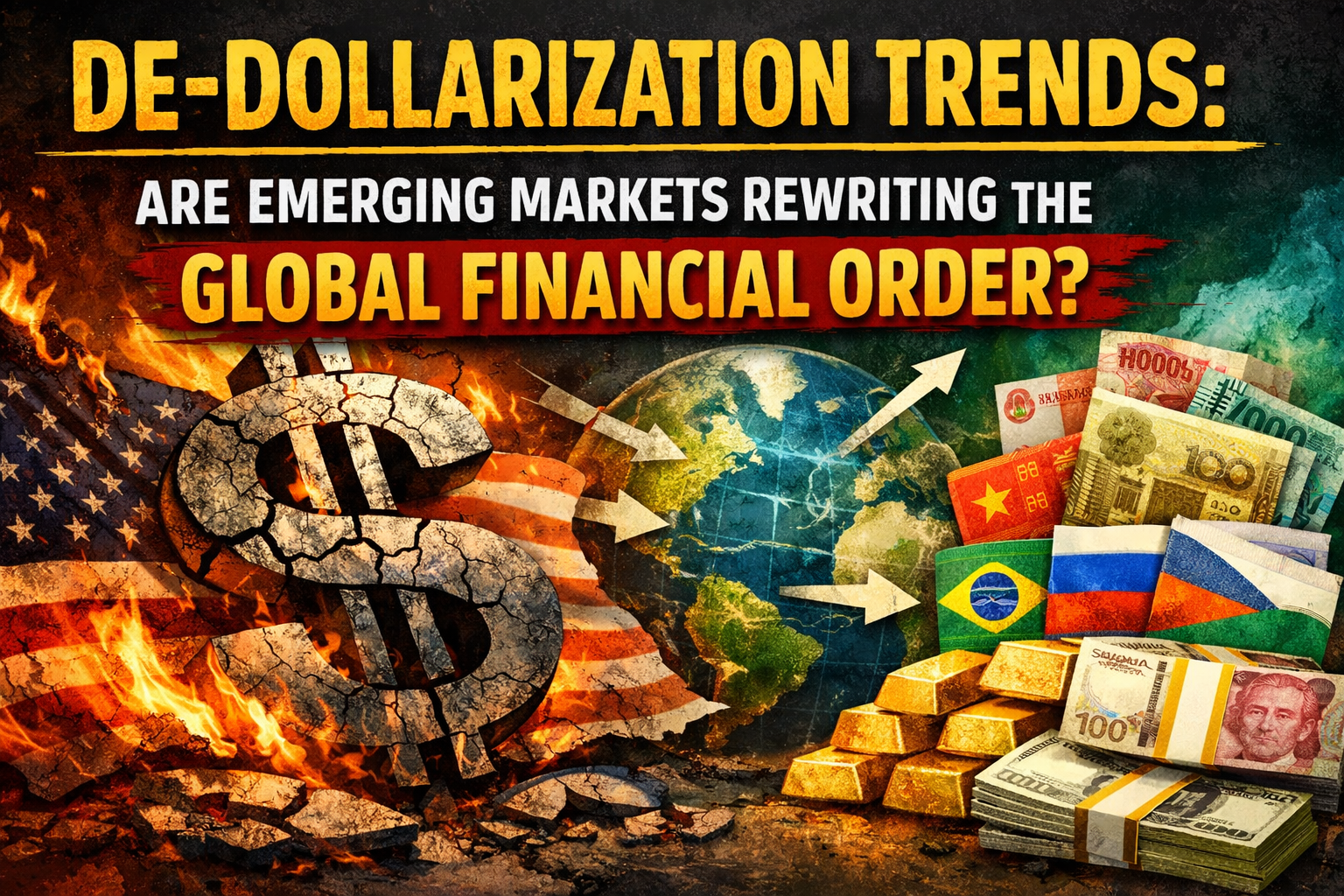
De-Dollarization Trends: Are Emerging Markets Rewriting the Global Financial Order?
Explore how emerging markets are reducing dependence on the U.S. dollar through trade agreements, alternative currencies, and new financial systems—and what it means for the future of global finance.
Table of Contents
Introduction: The Dollar’s Dominance Is Being Questioned
For more than 75 years, the U.S. dollar has been the backbone of global finance. It dominates:
- International trade settlements
- Central bank reserves
- Commodity pricing (especially oil and metals)
- Global debt markets
- Cross-border banking systems
But a quiet shift is underway.
Emerging economies are increasingly exploring ways to reduce reliance on the dollar, a movement widely referred to as de-dollarization. While not signaling the end of the dollar, this trend reflects growing ambitions to create a more multipolar financial system.
What Is De-Dollarization?
De-dollarization refers to the process by which countries:
- Conduct trade in local or alternative currencies
- Reduce U.S. dollar reserves
- Develop independent payment infrastructure
- Issue debt outside dollar-denominated markets
- Build bilateral currency agreements
It is less about replacing the dollar overnight and more about diversifying financial power.
Why Emerging Markets Are Driving This Shift
1. Reducing Exposure to U.S. Monetary Policy
When the U.S. Federal Reserve raises interest rates, global capital flows tend to shift toward dollar assets, often destabilizing emerging economies through:
- Currency depreciation
- Capital flight
- Higher borrowing costs
By trading in local currencies, nations aim to insulate themselves from external monetary shocks.
2. Geopolitical Risk and Financial Sovereignty
Recent geopolitical tensions and sanctions have highlighted the strategic risk of relying heavily on dollar-based systems.
Countries are increasingly asking:
Can access to global finance be influenced by political alignment?
This has accelerated efforts to build alternative settlement channels and reserve strategies.
3. Growth of South–South Trade
Trade between emerging economies—Asia, Africa, the Middle East, and Latin America—is expanding faster than trade with developed nations.
These transactions increasingly bypass the dollar, using:
- Bilateral currency swap agreements
- Direct local currency settlement
- Regional clearing mechanisms
4. Technological Leapfrogging in Financial Infrastructure
Digital payment systems and central bank digital currencies (CBDCs) are enabling countries to experiment with non-dollar trade rails without relying on legacy Western banking systems.
Key Mechanisms Powering De-Dollarization
Local Currency Trade Agreements
Countries are negotiating deals to settle imports and exports directly in their own currencies, eliminating the need for dollar conversion.
Currency Swap Lines Between Central Banks
These allow nations to access liquidity in partner currencies during trade or financial stress, reducing dependence on dollar funding.
Diversification of Foreign Exchange Reserves
Central banks are gradually increasing holdings of:
- Gold
- Regional currencies
- Alternative reserve assets
This reduces concentration risk tied to the dollar.
New Development and Lending Institutions
Emerging-market-led financial institutions are offering financing alternatives to traditional Western-dominated lenders.
Is the Dollar Actually Losing Power?
Despite the headlines, the dollar remains extraordinarily resilient due to:
- Deep and liquid U.S. capital markets
- Legal and institutional trust
- Global demand for dollar-denominated assets
- The scale of U.S. Treasury markets
- Entrenched use in commodities and finance
What we are witnessing is not replacement—but fragmentation.
The global system may evolve from a single-anchor model to a multi-currency ecosystem.
Implications for Investors and Businesses
1. Currency Volatility Will Become More Structural
A multipolar system introduces greater FX complexity, making currency management a strategic necessity.
2. Trade Finance Will Become Regionally Oriented
Supply chains may increasingly operate within currency blocs rather than a unified dollar framework.
3. Reserve Diversification Will Influence Capital Flows
Shifts in central bank reserve allocation can reshape demand for bonds, commodities, and alternative assets.
4. Financial Infrastructure Competition Will Intensify
Payment systems, clearing networks, and digital currencies will become arenas of geopolitical and economic influence.
What This Means for the Future Global Order
Rather than a sudden overthrow of dollar dominance, the world is likely entering a hybrid monetary era characterized by:
- Continued dollar leadership in global finance
- Stronger regional currency ecosystems
- Parallel settlement systems
- Increased monetary sovereignty among emerging nations
- Gradual erosion of a single-currency-centered model
In essence, globalization is not reversing—it is decentralizing.
Conclusion
De-dollarization is less about abandoning the U.S. dollar and more about reshaping how power is distributed in the international financial system.
Emerging markets are not trying to dismantle the existing order—they are building flexibility within it.
The result could be a world where the dollar remains dominant but no longer indispensable—a shift from financial unipolarity to strategic plurality.
FAQ Section (SEO Optimization)
Q1. What is de-dollarization in simple terms?
It is the effort by countries to reduce reliance on the U.S. dollar in trade, reserves, and financial systems.
Q2. Is the U.S. dollar going to lose reserve currency status?
Unlikely in the near term. However, its share of global usage may gradually decline as alternatives grow.
Q3. Why are emerging markets leading de-dollarization?
They seek protection from external monetary shocks, geopolitical risks, and dollar-driven financial cycles.
Q4. How will de-dollarization affect global investors?
It may increase currency diversification, alter capital flows, and create new regional financial opportunities.