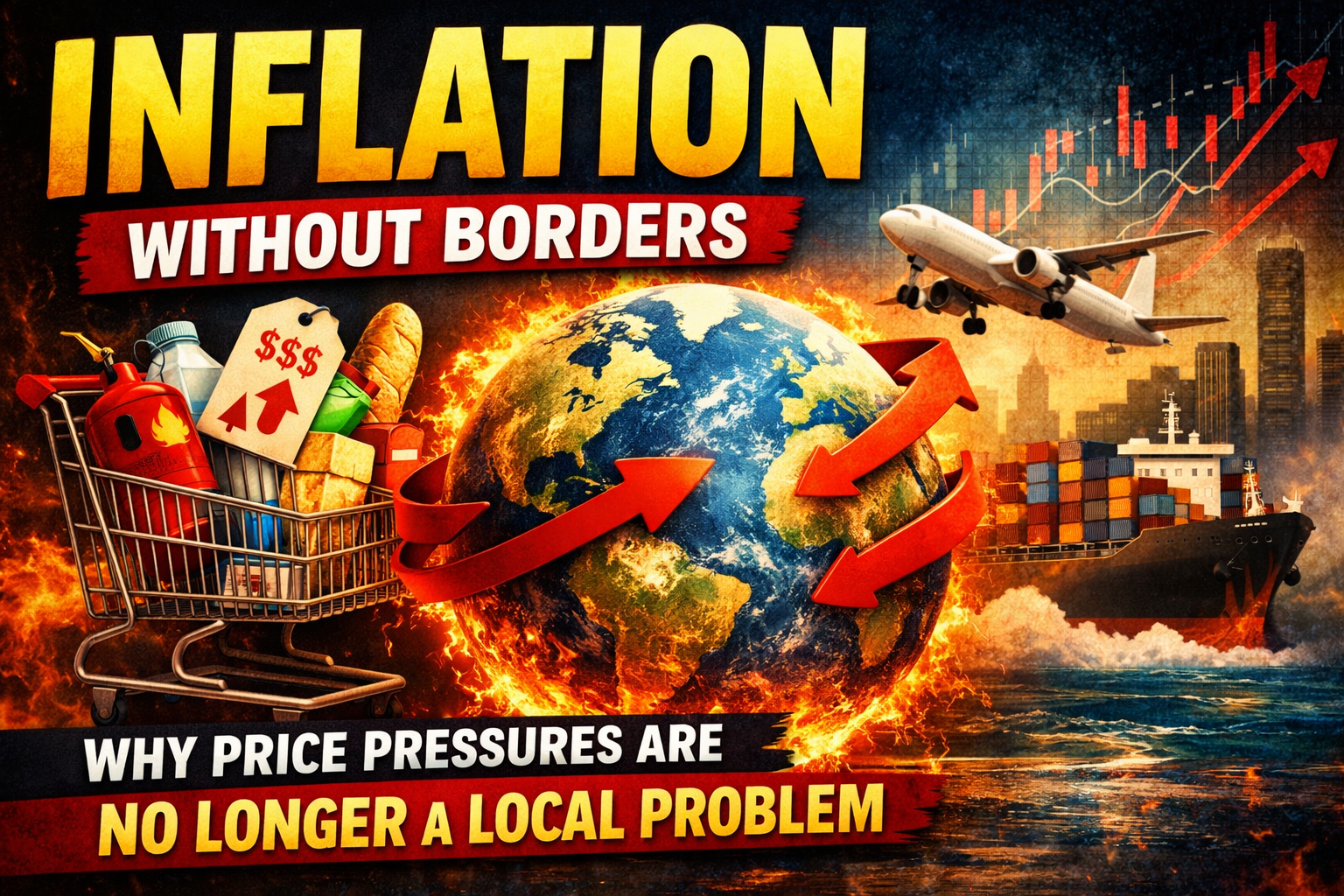
Inflation Without Borders: Why Price Pressures Are No Longer a Local Problem
Inflation is no longer confined to national economies. Learn how global supply chains, energy markets, and currency movements are driving synchronized price pressures worldwide.
Table of Contents
Introduction: A New Era of Shared Inflation
Inflation used to be explained by domestic conditions—strong demand, wage growth, or loose monetary policy within a single country. Today, that framework is outdated.
In an interconnected global economy, inflation behaves more like a transnational force. A shipping delay in Asia, an energy shock in Europe, or currency volatility in emerging markets can all translate into higher prices worldwide.
Inflation is no longer local. It is systemic and globally transmitted.
The Globalization of Cost Structures
Modern production is geographically fragmented. Few goods are made in one country from start to finish. Instead: Inflation Without Borders: Why Price Pressures Are No Longer a Local Problem
- Raw materials are sourced globally
- Components are manufactured across multiple nations
- Assembly occurs where labor or logistics are most efficient
- Products are distributed worldwide
This interconnected model means cost increases anywhere in the chain ripple through the entire system.
Supply Chains as Inflation Highways
When transportation costs surge or supply bottlenecks occur, businesses globally face higher input prices. These costs are passed on to consumers, synchronizing inflation across borders.
Energy: The Universal Inflation Multiplier
Energy is embedded in nearly every economic activity—from manufacturing and agriculture to digital infrastructure.
Because oil, gas, and electricity markets are internationally priced: Inflation Without Borders: Why Price Pressures Are No Longer a Local Problem
- Fuel increases raise shipping costs
- Fertilizer and food production become more expensive
- Construction and infrastructure costs escalate
- Service industries face higher operational expenses
An energy shock in one region becomes an inflationary force everywhere.
Commodity Markets Transmit Price Shocks Instantly
Global commodities such as wheat, metals, and industrial inputs are traded in integrated financial markets. Weather disruptions, export restrictions, or geopolitical instability affecting supply can trigger rapid global repricing.
This is why food and material inflation often rise simultaneously across continents—even in countries with no direct exposure to the original disruption.
Currency Movements and “Imported Inflation”
Exchange rates now play a critical role in shaping domestic inflation outcomes.
When a country’s currency weakens: Inflation Without Borders: Why Price Pressures Are No Longer a Local Problem
- Imports become more expensive
- Businesses pay more for foreign inputs
- Energy and commodities priced in stronger currencies surge locally
- Consumers feel inflation even without domestic demand growth
This phenomenon—imported inflation—is particularly visible in open, trade-dependent economies.
Monetary Policy No Longer Operates in Isolation
Interest-rate decisions by major economies influence financial conditions worldwide.
For example: Inflation Without Borders: Why Price Pressures Are No Longer a Local Problem
- Higher rates in large economies attract global capital flows
- Emerging-market currencies may depreciate
- Borrowing costs rise internationally
- Debt servicing becomes more expensive
These policy spillovers create inflationary or disinflationary effects far beyond national borders.
Why Inflation Cycles Are Becoming Synchronized
Several structural trends are aligning inflation patterns globally:
- Integrated logistics and trade systems
- Digitally connected financial markets
- Shared exposure to commodity benchmarks
- Climate-related disruptions affecting supply
- Rapid transmission of price signals through technology
The result is fewer isolated economic cycles and more co-movement in global inflation trends.
Implications for Policymakers
Governments can no longer rely solely on domestic tools to control inflation.
Key Shifts:
- Interest rates address demand—but not external supply shocks
- Trade resilience and supply diversification are now anti-inflation tools
- Energy independence and infrastructure investment influence price stability
- International coordination is becoming essential
Inflation management is evolving from national policy to global economic strategy.
Implications for Businesses and Investors
1. Cost Volatility Is Structural
Companies must manage exposure to logistics, energy, and currency fluctuations—not just local wages or taxes.
2. Pricing Requires Global Awareness
Firms increasingly track commodity indices and FX markets alongside domestic indicators.
3. Portfolio Diversification Must Be Geographic
Investors are allocating across regions and real assets to hedge against globally synchronized inflation shocks.
From Domestic Inflation to Systemic Inflation
| Traditional View | Emerging Reality |
|---|---|
| Inflation driven by local demand | Inflation transmitted through global systems |
| National policy as primary tool | Cross-border forces shape outcomes |
| Domestic supply constraints | Integrated global supply disruptions |
| Isolated economic cycles | Synchronized inflation waves |
The economic lens must shift from national analysis to network analysis.
The Future: Managing Inflation in an Interconnected Economy
Looking ahead, inflation dynamics will likely be influenced by: Inflation Without Borders: Why Price Pressures Are No Longer a Local Problem
- Energy transition costs and green infrastructure spending
- Geopolitical realignment of supply chains
- Climate variability affecting agriculture and resources
- Technological investment reshaping production costs
- Increasing regionalization of trade blocs
Inflation will not disappear—but it will remain deeply linked to how the world economy evolves structurally.
Conclusion
Inflation today travels through container ships, energy grids, digital markets, and currency exchanges. It is shaped as much by geopolitics and logistics as by domestic policy.
Understanding price stability now requires a global perspective.
Inflation is no longer something nations experience alone—it is something they navigate together.
FAQ Section
Q1. Why is inflation now considered global rather than local?
Because supply chains, commodities, and financial markets connect economies, allowing cost shocks to spread internationally.
Q2. What is imported inflation?
It occurs when currency weakness or higher global prices make imported goods more expensive domestically.
Q3. Can central banks fully control inflation anymore?
They can influence demand, but global supply and energy dynamics increasingly limit their control.
Q4. How should investors respond to global inflation trends?
By diversifying geographically, considering real assets, and monitoring currency and commodity exposure.